Every mile a truck drives before it even reaches the highway is a mile that eats into margin. That's why truck site selection, choosing where to build a truck stop, fleet depot, distribution terminal, or last-mile hub is one of the highest-leverage decisions a logistics or trucking business will ever make. Get it right, and you unlock lower transportation costs, faster turnaround times, and a network that scales with demand. Get it wrong, and you're stuck paying for it, literally for the next 10 to 20 years.
For decades, site selection in trucking and logistics leaned heavily on gut instinct, static maps, and a handful of spreadsheets. Today, that approach doesn't cut it. Fuel costs fluctuate, freight patterns shift overnight, e-commerce keeps redrawing the "last mile," and competitors are opening new terminals faster than ever. Businesses that want a durable edge need real-time, data-backed location intelligence and that's exactly where MapZot.AI comes in.
Why Truck Site Selection Is More Than Just "Finding Land"
It's tempting to think of truck site selection as a real estate exercise: find a plot near a highway, check the price per acre, and sign the lease. But the businesses that get the most value out of their network treat site selection as a strategic, data-driven process — because a poorly placed depot or terminal doesn't just cost more upfront, it quietly drains efficiency every single day it operates.
Transportation typically accounts for more than half of total logistics costs in the U.S., which means the location of your trucking infrastructure is one of the single biggest levers you have over your bottom line. A site that's five minutes closer to your core delivery zone, or positioned on the right side of a chronically congested interchange, can compound into massive savings — or losses — over the life of the facility
The Core Factors That Drive a Winning Truck Site
1. Proximity to Freight Corridors and Delivery Points
The closer your site sits to the customers, retailers, or distribution points it serves, the less you spend on fuel, driver hours, and vehicle wear. Sites positioned near major interstate corridors or freight-heavy intersections consistently outperform those tucked away from the flow of traffic.
2. Traffic Patterns and Drive-Time Analysis
Raw distance on a map can be misleading. What matters is real drive time — accounting for congestion, seasonal traffic swings, and time-of-day patterns. A site that looks perfectly centered on a map might actually add 20 minutes to every run once rush-hour congestion is factored in.
3. Access to Highways and Road Infrastructure
Truck-specific infrastructure, turning radii, weigh stations, road quality, bridge clearances, and highway on/off-ramp access, can make or break daily operations. A site with poor ingress and egress creates bottlenecks that no amount of internal efficiency can fix.
4. Real Estate and Land Costs
Land near major freight corridors commands a premium, and costs vary widely by market. The goal isn't always to find the cheapest site — it's to find the site with the best cost-to-efficiency ratio, factoring in how much a slightly pricier location saves in transportation costs over time.
5. Zoning, Regulatory, and Environmental Constraints
Industrial zoning, noise ordinances, environmental restrictions, and permitting timelines can quietly derail a promising site. These constraints need to be mapped early, not discovered after a lease is signed.
Where Traditional Site Selection Falls Short
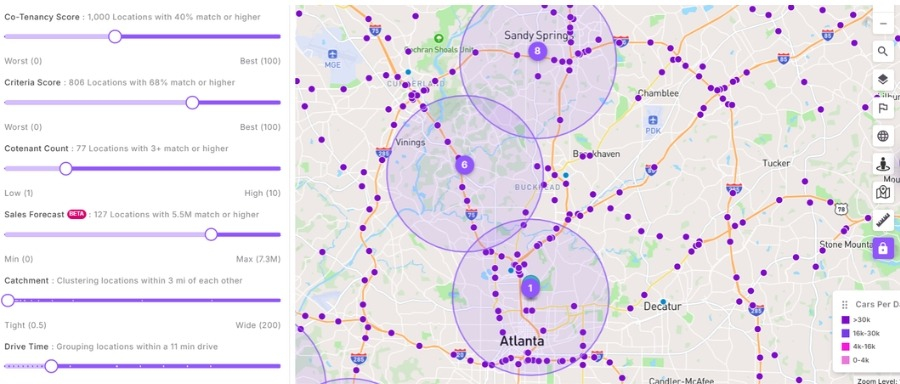
The factors above sound straightforward, but pulling them together manually is where most teams get stuck. Traffic counts live in one dataset, zoning maps in another, labor statistics somewhere else entirely and by the time it's all stitched together in a spreadsheet, the data is already stale. Freight patterns and consumer demand shift constantly, and static, one-time analysis simply can't keep pace.
This is the gap that modern, AI-driven location intelligence platforms are built to close.
Turning Site Selection Into a Repeatable, Data-Driven Process
The trucking and logistics companies that scale successfully aren't the ones that get lucky on one great site. They're the ones that build a repeatable, data-driven process for evaluating every new location, so each new terminal, depot, or truck stop is measurably better positioned than a guess would have produced.
Truck site selection will always involve trade-offs between cost, accessibility, labor, and regulation. The difference between a mediocre network and a high-performing one comes down to whether those trade-offs are made with real data, or without it.
Ready to Choose Your Next Site with Confidence?
If your team is evaluating new terminals, depots, or truck stop locations, don't leave it to spreadsheets and instinct. See how MapZot.AI's location intelligence platform can help you identify, compare, and validate your next site — backed by real-time data, not guesswork.