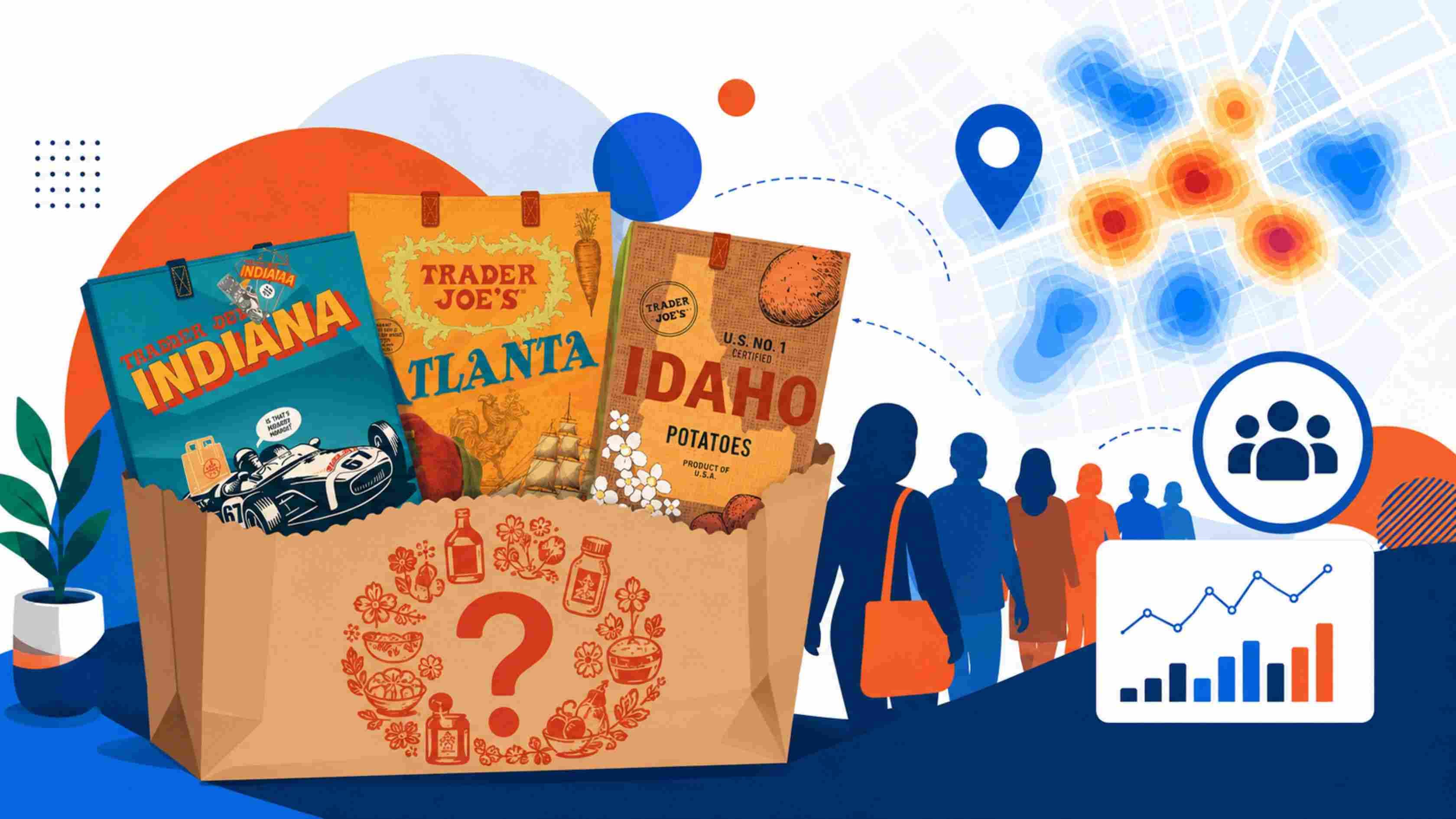
Every holiday season, a $2.99 paper bag with a question mark on it turns one of America's favorite grocery chains into a treasure hunt. Trader Joe's Mystery Packs, each holding three reusable tote bags with surprise designs, have become a TikTok staple, an eBay flipping market and, for many shoppers, a reason to make an extra trip.
But what does the hype look like on the ground? We pulled foot traffic data from the MapZot.AI dashboard for a Trader Joe's in Grosse Pointe, Michigan (17028 Kercheval Ave) to see how many people visit, where they come from, how long they stay and where else they shop.
What Are Trader Joe's $3 Mystery Bags?
A Mystery Pack is a sealed brown bag priced at $2.99 that contains three reusable shopping bags. Trader Joe's says each pack includes designs that cannot be bought individually, plus regional designs celebrating stores around the country. You do not know which bags you have until you open it, and duplicates are part of the fun (and the frustration).
Trader Joe's told the media the 2026 packs would arrive in stores nationwide in early November, with two never-before-seen designs. Coverage from Daily Voice, Parade and PEOPLE via Yahoo reflects how much anticipation builds: the packs sold out quickly in 2025, and resale listings on eBay have ranged from a few dollars for a single bag to as much as $100 for a set of three.
That scarcity-plus-surprise formula is exactly the kind of draw that can pull shoppers across town. So let's look at the traffic.
Visit Volume: A 4.2% Lift in November
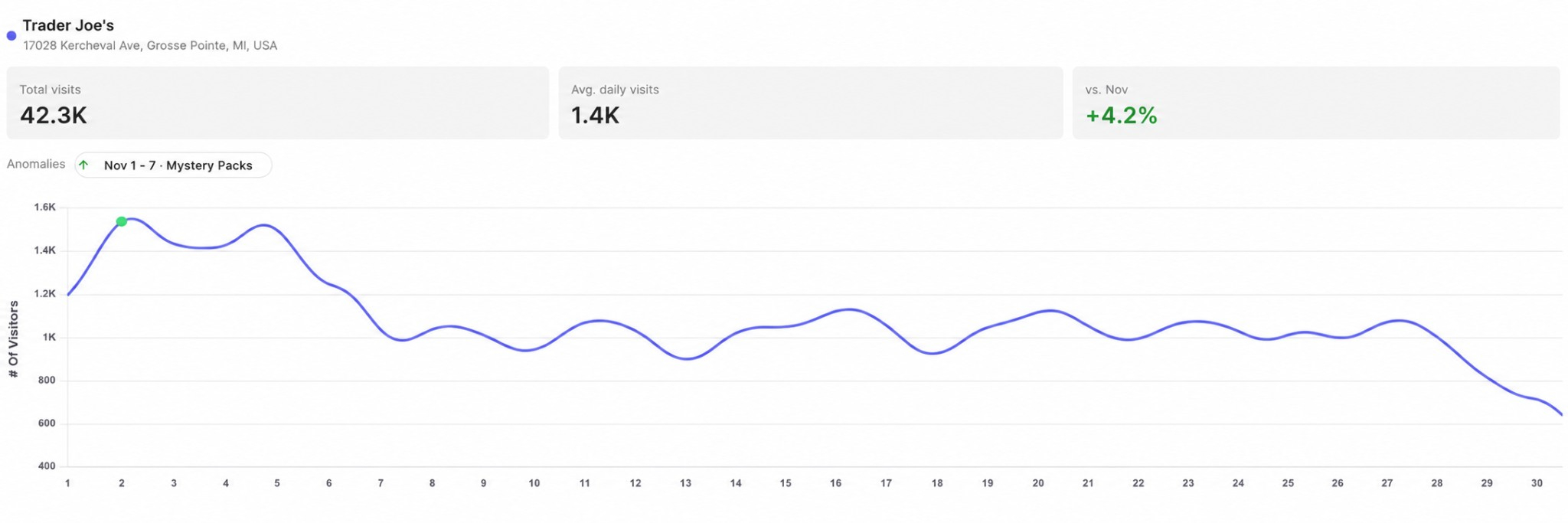
The store logged 42.3K visits in November, an average of roughly 1.4K a day, and finished 4.2% above October. Traffic climbed through the middle of the month, with local peaks around Nov 2 and Nov 5 (both roughly 1.4K to 1.5K visitors)
The lesson is simple: weather moves grocery traffic as much as any promotion does. When you measure the impact of a product launch like the Mystery Packs, you have to separate it from days like these, or you will credit (or blame) the wrong thing.
Trade Area: Where Do Trader Joe's Shoppers Come From?
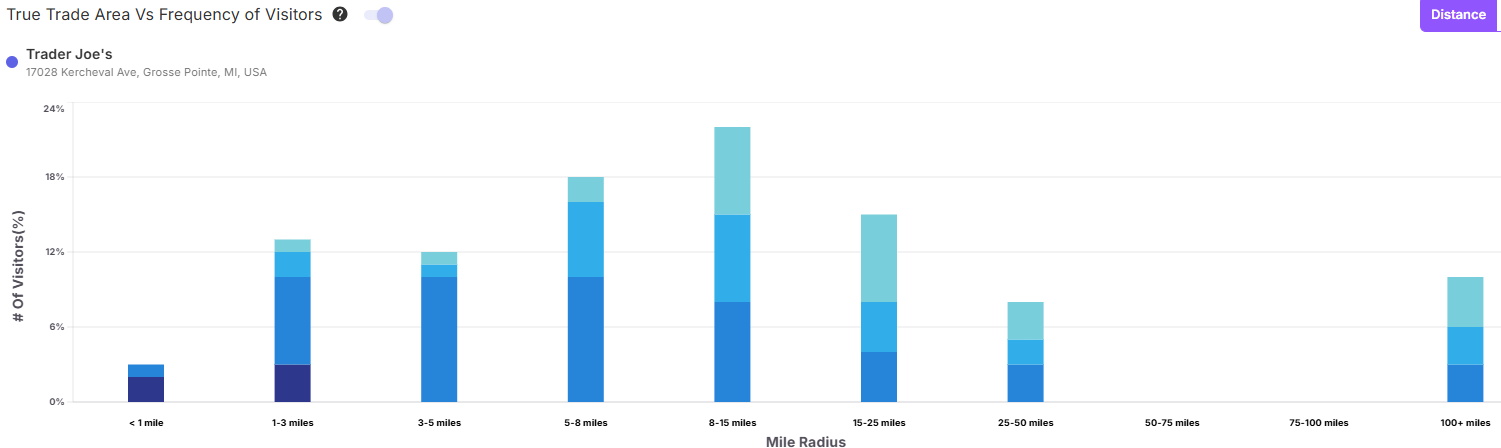
This is the most surprising chart in the set. Trader Joe's is not a classic "walk-to" neighborhood grocer. Reading the dashboard:
Roughly two-thirds of visitors live within 15 miles, and the single biggest slice comes from the 8–15 mile ring, not the immediate neighborhood. Fewer than one in five visitors comes from within 3 miles. That is the signature of a destination store: people choose to drive past other grocers to get here.
There is also a distinct group, around 10% of visitors, from 100+ miles away. These are likely travelers, seasonal residents or visitors to the area, and they are exactly the audience that treats a limited-edition item like a Mystery Pack as a souvenir worth hunting for.
The stacked colors in the chart show visit frequency. The darkest segments are the most frequent visitors, and they concentrate in the nearest rings (under 3 miles). Farther rings skew toward occasional visits. In other words, nearby residents are the regulars, while the wider trade area supplies the occasional, trip-driven traffic that a viral drop can amplify.
Length of Stay: A 62-Minute Average, and Two Very Different Visitors
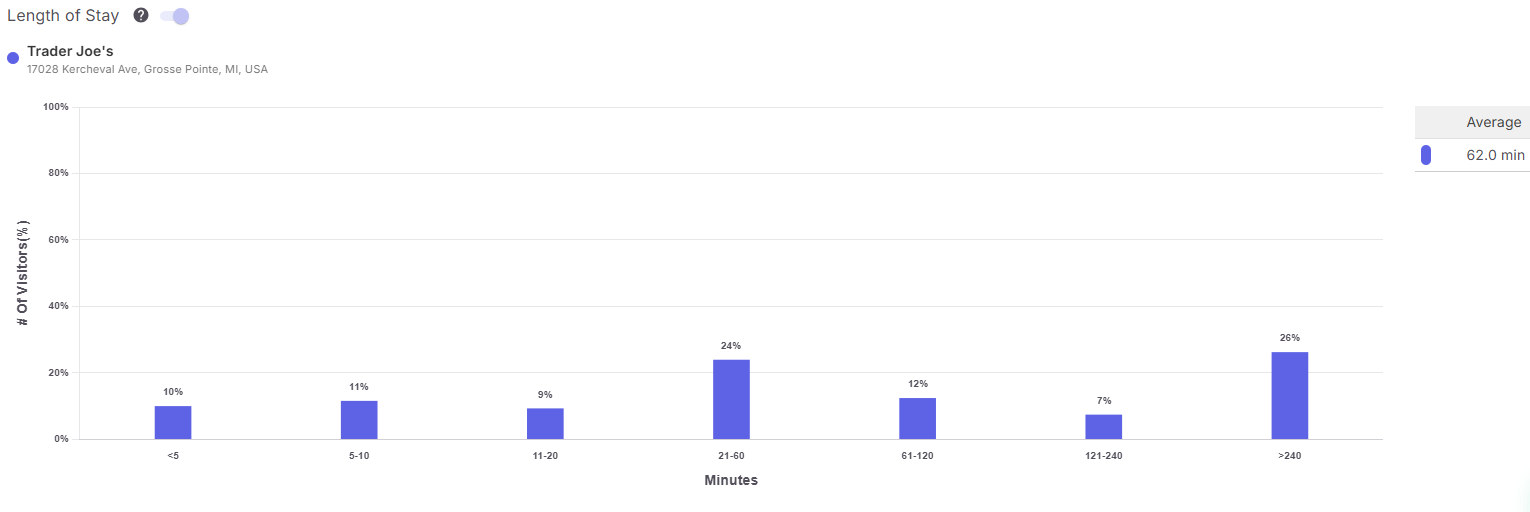
The average visit lasts 62 minutes, but the average hides a split:
Quick trips (under 20 minutes): about 30% of visits (10% under 5 minutes, 11% for 5–10, 9% for 11–20). Think grab-and-go: a bag of snacks, a bottle of wine, or a Mystery Pack at the register.
The classic shop (21–60 minutes): 24%, the largest single bucket below an hour.
Long stays (over 60 minutes): about 45%, including 26% over four hours.
That 26% in the 240+ minute bucket is almost certainly not shoppers. In foot traffic data, very long dwell times typically reflect employees and people working nearby, which is why we recommend filtering staff out before drawing conclusions about shopper behavior. Once you do, the real customer pattern is dominated by short and medium visits, which is exactly what a $3 impulse buy is built for.
Cross-Visit Patterns: Where Else Do Trader Joe's Shoppers Go?
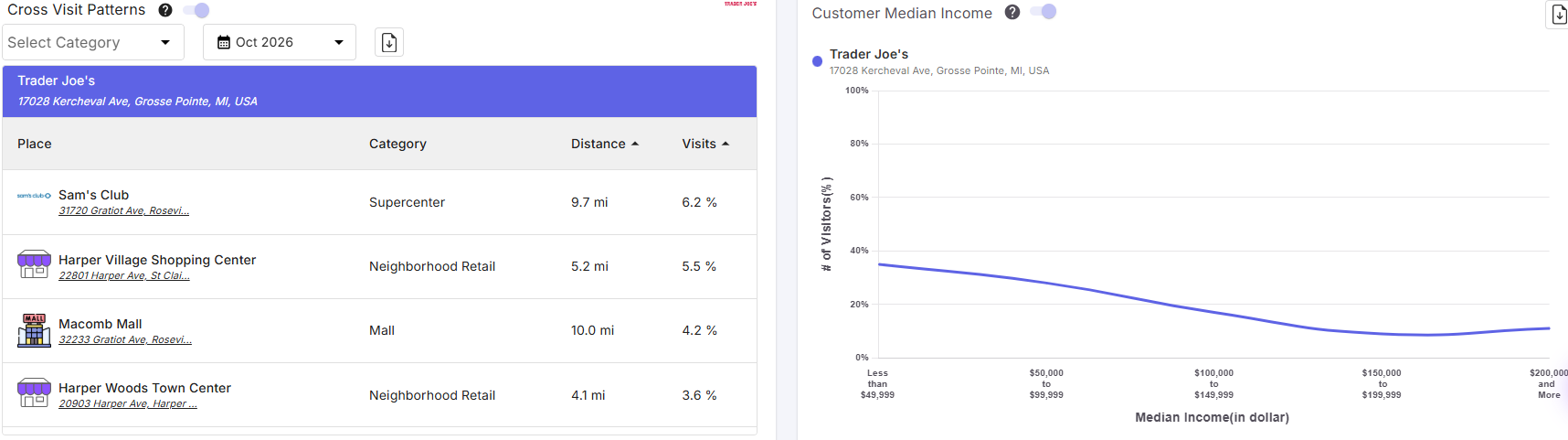
Trader Joe's shoppers are bargain-minded and trip-chaining. The top cross-visited location is Sam's Club (6.2%), a bulk-buying supercenter roughly ten miles away, followed by two neighborhood retail centers and Macomb Mall. Shoppers pair Trader Joe's curated, small-format experience with big-box stock-ups and errands.
For brands and landlords, this is useful. A Mystery Pack run can turn a Trader Joe's stop into a wider shopping trip, and it shows which centers share the same customers.
The right-hand chart in the same dashboard view plots the median income of the neighborhoods visitors come from. By our read of the curve, the distribution is front-loaded:
Roughly 35% of visitors come from areas with median income under $50K.
About 28% come from the 50K–99,999 band.
Roughly 18% come from 100K–149,999, and about 9% from 150K–199,999.
An uptick of around 11% comes from $200K+ areas.
That means around 60% of visitors live in areas with median incomes under $100K, which challenges the stereotype of Trader Joe's as strictly an affluent-shopper brand. A $2.99 collectible with a low price of entry fits that audience well, while the higher-income bump suggests the store still draws from premium neighborhoods nearby.
Takeaways for Retailers, Brands and Real Estate Teams
Viral products widen the trade area. A store whose biggest ring is already 8–15 miles is primed for limited-edition drops to pull in occasional, long-distance visitors.
Plan around weather. One storm day swung traffic from about 1.6K to about 500 visitors in 48 hours. Launch calendars and staffing should reflect it.
Separate staff from shoppers. Dwell-time averages are misleading until long-stay employee visits are filtered out.
Use cross-visit data to find partners. Sam's Club and nearby neighborhood retail centers share this audience, which makes them natural co-marketing or site-selection signals.
Measure the launch, not just the month. Comparing a pre-launch baseline (like October here) against post-launch weeks isolates the real lift from products like the Mystery Packs