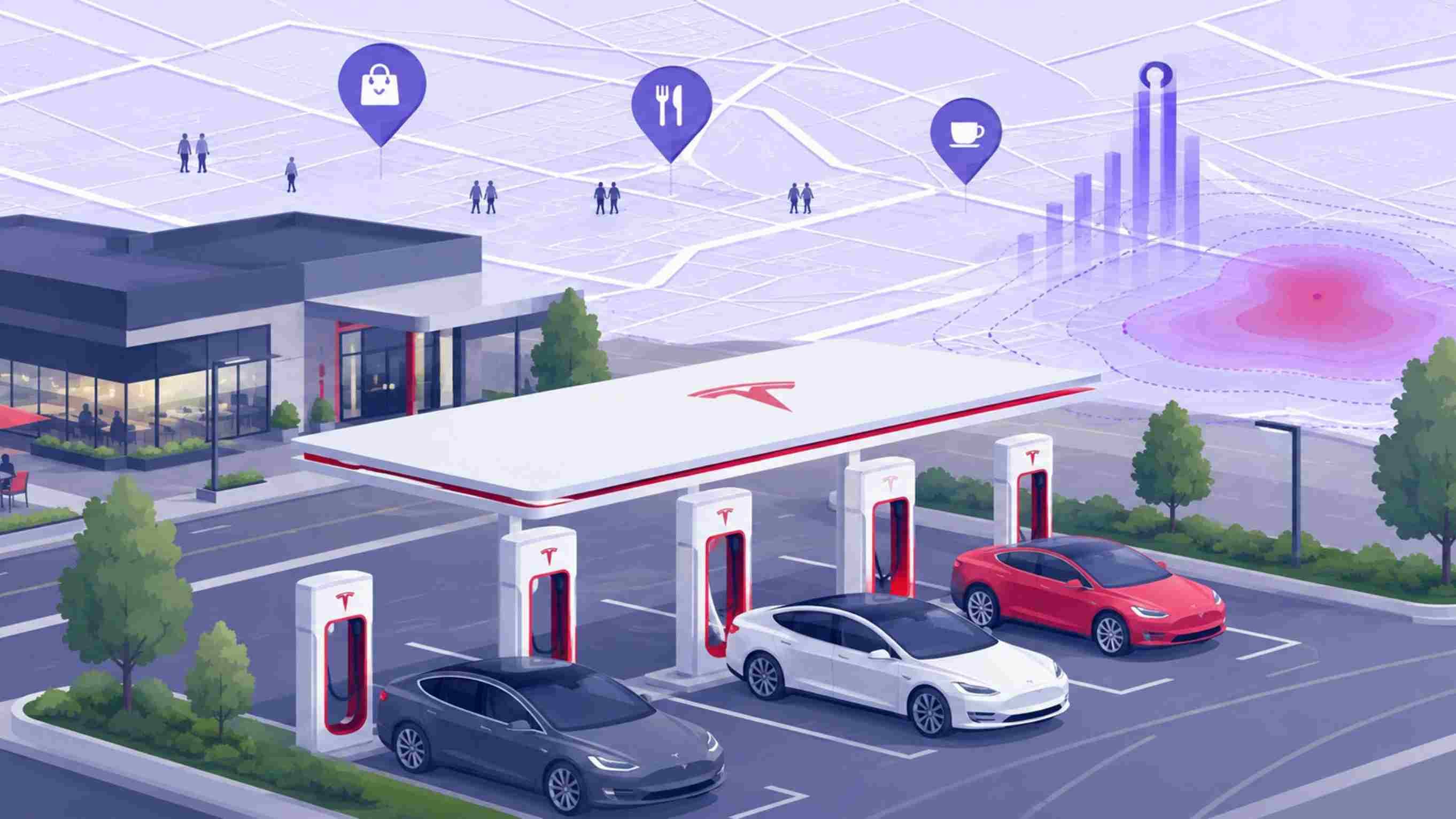
Tesla Superchargers are no longer just a convenient stop for electric vehicle drivers.
They are becoming destinations.
As electric vehicle adoption continues to reshape consumer mobility, charging infrastructure is playing an increasingly important role in determining where people stop, how long they stay, and which surrounding businesses benefit from their visits.
For Tesla, the expansion of its Supercharger network represents more than an investment in EV infrastructure. Every charging location creates a new point of consumer activity, bringing drivers to retail centers, restaurants, convenience stores, hotels, and other businesses.
But as the charging landscape becomes increasingly competitive, one question becomes critical:
How do EV charging companies identify the right locations for their next station?
The answer lies in location intelligence.
Tesla Superchargers Are Creating New Consumer Destinations
A traditional gas station visit is often quick and transactional. EV charging, however, can create a longer dwell time.
While vehicles charge, drivers may:
Grab a coffee
Visit a restaurant
Shop at nearby retailers
Run errands
Spend time at an entertainment destination
Stay overnight at a nearby hotel
This creates an opportunity for businesses and property owners located near charging infrastructure.
A strategically located Tesla Supercharger can contribute to a larger ecosystem of consumer activity. The location of the charger, therefore, matters just as much as the technology itself.
A Supercharger positioned near a busy retail center may generate a very different pattern of activity than one located along a highway or in a suburban commercial corridor.
Understanding those differences requires more than simply identifying available real estate.
It requires understanding how people move.
The Location Challenge Behind EV Charging Expansion
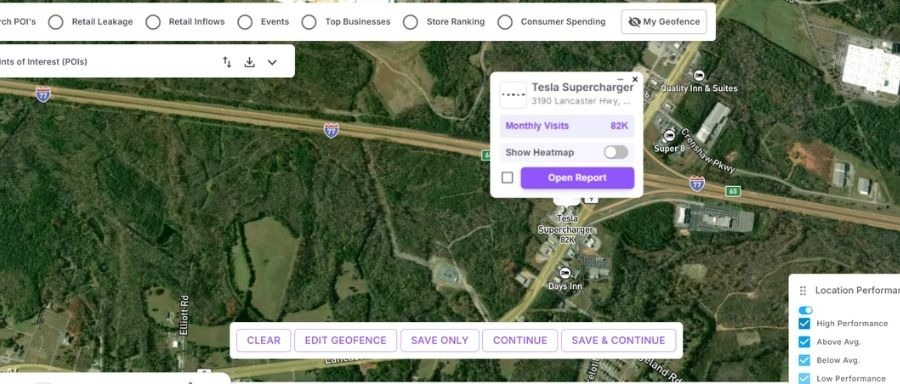
Choosing a location for EV infrastructure involves several layers of analysis.
Companies need to consider:
Traffic patterns: How many vehicles travel through the area?
Consumer mobility: Where are people coming from, and where are they going?
Dwell time: How long do visitors typically spend in the surrounding area?
Nearby businesses: Are there complementary destinations that can improve the charging experience?
Market demand: Does the area have sufficient potential EV traffic?
Competition: How many charging options already exist nearby?
Future development: Will new residential, commercial, or retail projects increase demand?
A location may appear attractive on a map while failing to generate sufficient demand in reality.
Conversely, an overlooked commercial corridor may offer strong mobility patterns, limited charging competition, and significant future potential.
This is where location intelligence can make a meaningful difference.
From Traffic Data to Smarter Charging Locations
The future of EV infrastructure planning will increasingly depend on the ability to analyze real-world movement
MapZot.AI helps businesses move beyond traditional demographic and location analysis by bringing multiple layers of location intelligence into one platform.
For EV charging infrastructure, this could include analyzing:
Vehicle and consumer traffic patterns
Nearby businesses and points of interest
Competitive locations
Consumer movement trends
Market activity
Trade areas
Planned developments
Site characteristics and surrounding demand drivers
Instead of evaluating locations based on intuition alone, businesses can use data to identify markets with stronger potential.
For example, a high-traffic location may initially appear ideal for a new charging station.
But what if consumers only pass through the area without stopping?
Alternatively, a location with moderate traffic but strong nearby dwell time, restaurants, retail activity, and consumer spending could potentially create a more valuable charging destination.
The key is understanding what happens around a location—not just how many people pass by it.
Tesla Superchargers and the Rise of the Charging Economy
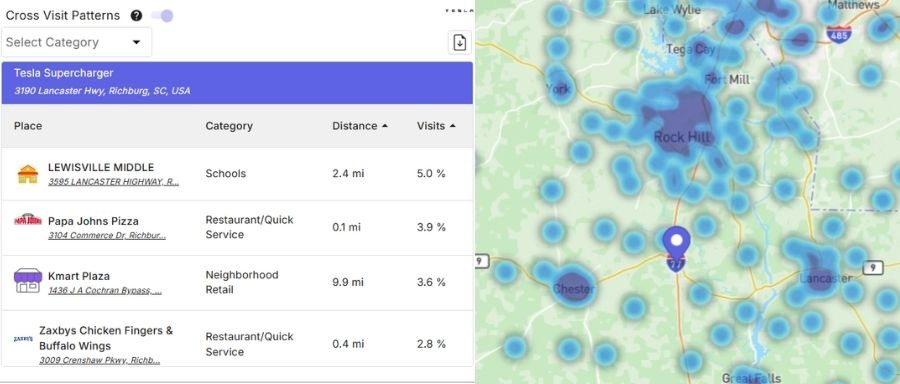
The growth of EV charging infrastructure is creating new opportunities for commercial real estate.
Retail centers and shopping destinations can potentially attract EV drivers by offering convenient charging alongside food, shopping, and entertainment.
Restaurants can benefit from consumers looking for something to do while their vehicle charges.
Hotels can provide an additional amenity for EV-driving guests.
Convenience-focused businesses can capture visits from drivers during charging stops.
This creates what could be described as a new charging economy—where EV infrastructure and commercial destinations increasingly influence each other.
For property owners, the question becomes:
Could EV charging infrastructure increase the attractiveness of a commercial location?
For charging companies, the question is equally important:
Which businesses and destinations can create the best experience for EV drivers?
Location intelligence helps answer both.
Why Mobility Data Matters for EV Infrastructure
Traditional site selection has often relied heavily on population, income, and demographics.
These data points remain important—but they do not tell the complete story.
Two locations may have similar populations and household incomes while experiencing completely different patterns of consumer movement.
One area may experience strong daily traffic because of offices and retail activity.
Another may attract significant weekend visitors.
A third may serve as an important travel corridor.
For EV charging infrastructure, these differences matter.
Mobility data provides an additional layer of intelligence by helping businesses understand how consumers interact with real-world locations.
Using MapZot.AI, businesses can explore location data and mobility insights to make more informed decisions about expansion opportunities.
The result is a more comprehensive approach to site selection—one that looks beyond static maps and demographics.
The Future of Tesla Supercharger Site Selection
The EV charging industry is entering a new phase.
As charging networks expand, the focus will increasingly shift from simply increasing the number of locations to improving the strategic quality of those locations.
The next generation of charging infrastructure planning will likely require businesses to evaluate:
Demand + Mobility + Competition + Commercial Activity + Future Growth
This is where AI-powered location intelligence has the potential to transform the decision-making process.
Rather than manually evaluating hundreds of markets and potential sites, businesses can use technology to analyze multiple location factors more efficiently and identify opportunities that may otherwise go unnoticed.
For companies operating in the EV ecosystem, this could mean faster market analysis, smarter expansion strategies, and more confident site selection decisions.