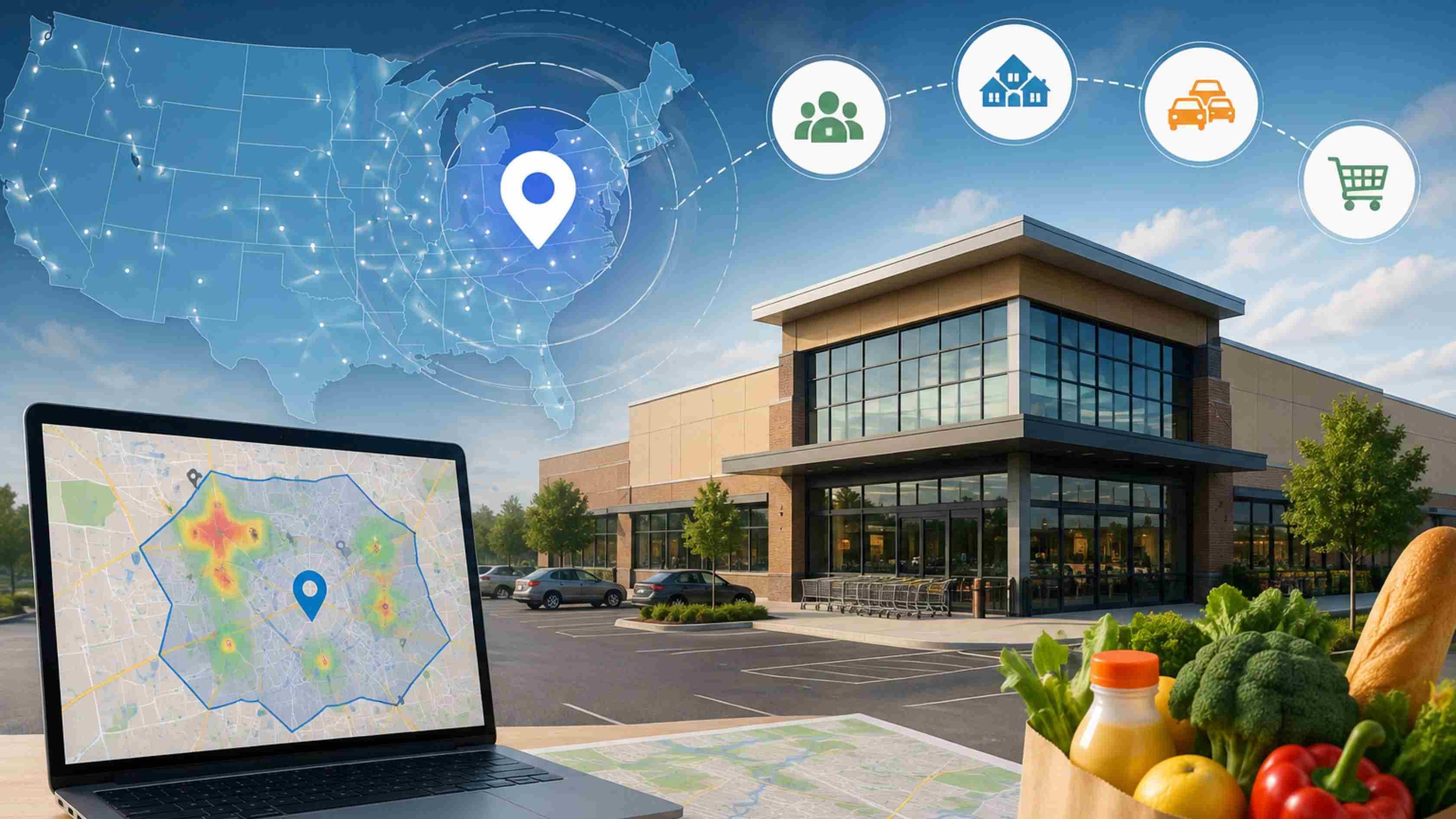
Choosing the right location is one of the most important decisions when opening or expanding a grocery store. A strong location can help attract consistent foot traffic, serve an underserved market, and support long-term sales. The wrong location can lead to low customer visits, intense competition, poor accessibility, and limited growth potential.
For grocery retailers, site selection goes beyond finding an available property. It requires understanding where customers live, how they travel, what they spend, which competitors are nearby, and whether the surrounding market can support another store.
This guide explains the key factors retailers should consider when evaluating grocery store locations across the U.S.
Key Takeaways
Grocery store site selection starts with understanding the target customer and trade area.
Population, household income, household size, and consumer behavior can influence store potential.
Traffic patterns, accessibility, parking, and visibility are important for grocery locations.
Competition should be evaluated within the store's realistic trade area.
New residential and commercial developments can indicate future demand.
Market gaps and underserved neighborhoods can reveal potential expansion opportunities.
Comparing multiple sites using consistent location criteria can make the site selection process more structured.
A grocery store site submission process can help retailers and real estate teams evaluate potential properties before moving forward.
Why Location Matters for an Organic Pet Store
Grocery shopping is typically a recurring activity, which makes convenience an important part of the customer decision.
Customers often prefer stores that are easy to reach from their homes, workplaces, schools, and daily travel routes. As a result, a grocery store may perform differently depending on its surrounding population, road network, competition, and accessibility.
A location with a large population does not automatically make it a strong grocery opportunity. Retailers need to understand who lives in the area, where they shop, how frequently they travel, and whether existing grocery stores are meeting local demand.
This is why grocery store site selection often combines demographic, geographic, competitive, and mobility data.,
1. Define the Target Market
Before evaluating individual properties, retailers should define the customer profile they want to serve.
Depending on the grocery concept, relevant characteristics may include:
Population density
Household income
Household size
Age distribution
Family composition
Homeownership and rental patterns
Consumer spending behavior
Residential density
Daytime population
Lifestyle and shopping preferences
For example, a neighborhood-focused supermarket may prioritize dense residential areas, while a specialty grocery concept may look for markets with a specific consumer profile.
Clearly defining the target market makes it easier to identify locations where the potential customer base already exists.
2. Analyze the Grocery Store Trade Area
A grocery store's trade area represents the geographic area from which it is likely to attract customers.
Trade areas can vary based on:
Store format
Market density
Road infrastructure
Competition
Population distribution
Travel times
Shopping habits
Urban or suburban environment
Instead of relying only on a simple radius around a property, retailers can analyze actual travel patterns and geographic barriers to understand the potential customer base more realistically.
A trade area analysis can help answer questions such as:
How many households are within the expected trade area?
What is the population growth rate?
What is the average household income?
How much grocery competition exists?
Are there underserved neighborhoods nearby?
How accessible is the site from surrounding residential areas?
3. Evaluate Population and Demographics
Demographic analysis is a fundamental part of grocery store location analysis.
Retailers should examine the population surrounding each candidate site and compare it with their target customer profile.
Important demographic indicators include:
Population Density
Higher population density can create a larger potential customer base, particularly for neighborhood and urban grocery formats.
Household Income
Income levels can help retailers understand purchasing power and determine whether the market aligns with their pricing and product strategy.
Household Size
Larger households may have different grocery shopping patterns compared with smaller households, singles, or empty-nester households.
Population Growth
A growing population can indicate increasing future demand. However, growth should be evaluated alongside new housing development, competition, infrastructure, and other market factors.
4. Study Competition
Competition is another major consideration when selecting a grocery store location.
Retailers should map existing supermarkets, discount grocers, specialty grocery stores, convenience stores, warehouse clubs, and other businesses that may compete for grocery spending.
Competitive analysis can help identify:
Areas with high grocery concentration
Markets with limited grocery options
Competitor store locations
Distance between competing stores
Overlapping trade areas
Potential market gaps
Competition is not always a negative signal. A strong cluster of retailers may indicate established consumer demand. The important question is whether the proposed location can attract enough customers within its market.
5. Examine Traffic and Accessibility
Convenience is critical for grocery shopping.
A site may have a strong demographic profile but still underperform if customers have difficulty accessing it.
Retailers should consider:
Daily traffic volumes
Peak-hour traffic
Road connectivity
Turning movements
Intersection access
Nearby highways
Traffic signals
Pedestrian accessibility
Public transportation
Parking availability
Site visibility
Understanding how customers move through an area can provide additional context when comparing grocery store sites.
6. Consider Co-Tenancy and Nearby Businesses
The businesses surrounding a grocery store can influence customer traffic and shopping patterns.
Potentially relevant co-tenants and nearby businesses include:
Restaurants
Pharmacies
Banks
Fitness centers
Retail stores
Shopping centers
Schools
Healthcare facilities
Entertainment venues
A grocery store located near complementary businesses may benefit from customers combining multiple errands in the same trip.
What Is Grocery Store Site Submission?
Grocery store site submission is the process of presenting a potential property for evaluation against a retailer's site selection requirements.
A retailer, broker, developer, or real estate representative may submit a property with information such as:
Property address
Parcel information
Available space
Site plan
Demographic information
Traffic data
Nearby businesses
Competition
Development information
Property ownership or leasing details
The submitted location can then be evaluated against the retailer's defined criteria.
A structured site submission process can help real estate teams organize potential locations and determine which properties deserve deeper analysis.
Common Grocery Store Site Selection Mistakes
1. Focusing Only on Population
A large population does not necessarily mean strong grocery potential. The population must align with the retailer's target market and purchasing behavior.
2. Ignoring Competition
Opening near several established competitors requires a clear understanding of market demand and customer behavior.
3. Using Outdated Data
Markets can change quickly. New housing, businesses, roads, and competitors can change the characteristics of a trade area.
4. Overlooking Accessibility
A highly visible property may still be difficult to reach. Access, traffic patterns, parking, and road connectivity should be evaluated together.
5. Ignoring Future Development
A location that appears average today may have significant future potential if surrounding residential and commercial development is underway.
6. Evaluating Sites Individually
Without comparing multiple properties using consistent criteria, it can be difficult to identify meaningful differences between candidate locations.
Final Thoughts
Finding the right grocery store location requires more than finding an available property. Retailers need to understand the customers surrounding the site, the competitive landscape, accessibility, consumer movement, real estate characteristics, and future market development.
Whether a retailer is entering a new market, expanding an existing network, relocating a store, or evaluating broker-submitted properties, a data-driven grocery store site selection process can help organize the decision-making process.
The goal is not simply to find a property. It is to find a location where the market, customer demand, accessibility, competition, and site characteristics align with the grocery store's expansion strategy.
Explore Grocery Store Site Opportunities
Retailers and real estate teams can use site submission and location intelligence to evaluate potential grocery store properties, compare markets, and identify locations that align with their site selection criteria.