
Choosing the right location is one of the most important decisions for an organic pet store. A strong product assortment may attract customers, but the right location puts the store closer to households that are most likely to purchase premium, natural, and organic pet products.
For organic pet retailers, traditional factors such as population and foot traffic are only part of the picture. Geographic and demographic factors can reveal whether a market has the right combination of pet ownership, household characteristics, spending power, accessibility, and competitive supply.
This is where organic pet store location analysis becomes valuable.
Key Takeaways
Pet ownership should be evaluated at the trade-area level, not just at the city level.
Household income can help identify markets with greater potential for premium pet products.
Urban, suburban, and mixed-use neighborhoods can have very different customer profiles.
Proximity to complementary businesses such as veterinarians, groomers, dog parks, and pet services can influence store demand.
Competition and existing pet-store locations help identify underserved areas.
Mobility and visit data can provide additional context beyond static demographic information.
The strongest location strategy combines geographic, demographic, behavioral, and competitive data.
Why Location Matters for an Organic Pet Store
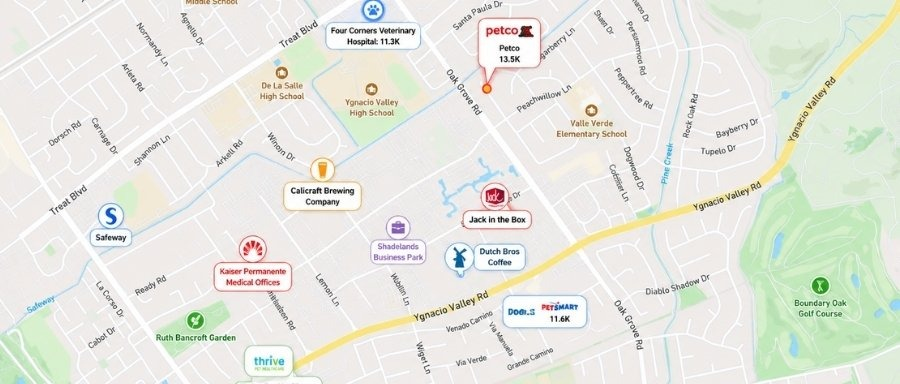
Organic and natural pet products often appeal to consumers who pay close attention to ingredients, pet health, sustainability, and product quality.
That means an organic pet store does not necessarily need the location with the highest overall population. It needs access to the right population.
Two neighborhoods can have similar population counts but very different characteristics.
One may have a high concentration of pet-owning households, higher disposable income, and several complementary pet businesses. Another may have similar population density but lower demand for premium products.
Understanding these differences can help retailers move beyond simple population-based site selection.
1. Pet Ownership Is a Core Geographic Factor
The first question in an organic pet store location analysis should be:
How many potential pet-owning households are within the store's realistic trade area?
Pet ownership can vary significantly between neighborhoods and geographic markets.
Research on dog ownership in India, for example, has found geographic and socioeconomic differences in ownership patterns, illustrating why pet-related businesses should avoid assuming that demand is uniform across a market.
For a U.S. retailer, useful geographic indicators can include:
Pet-owning household concentration
Dog and cat ownership
Household density
Residential growth
Homeownership
Apartment and multifamily density
Average household size
New residential development
Mapping these variables can help identify neighborhoods where the potential customer base is concentrated.
2. Household Income Can Influence Premium Pet Product Demand
Organic pet food, natural treats, supplements, grooming products, and specialty accessories can carry a higher price point than conventional alternatives.
As a result, household income is an important demographic factor to examine when evaluating a potential location.
Income data can help retailers understand the spending environment around a potential site. But income should not be evaluated in isolation.
A market with high household income but low pet ownership may not be as relevant as a market with a strong combination of:
Pet ownership + household income + population density + accessibility.
The goal is not simply to find the wealthiest neighborhood. It is to find neighborhoods where the customer profile aligns with the product offering.
3. Urban vs. Suburban Geography Matters
The geographic characteristics of a market can influence how customers shop for pet products.
Urban Markets
Urban neighborhoods may offer:
High population density
Apartment and multifamily housing
Younger professional populations
Walkable retail districts
Higher daytime populations
Strong demand for convenience
For smaller organic pet boutiques, dense mixed-use neighborhoods may create opportunities to serve customers who prefer convenient, specialized retail.
Suburban Markets
Suburban markets may offer:
Larger residential trade areas
Higher concentrations of single-family homes
Greater parking availability
Family-oriented demographics
Growing residential communities
Larger-format retail centers
The right strategy depends on the store's format, assortment, price point, and target customer.
This is why geographic analysis should evaluate how people live and move through an area, rather than simply categorizing a market as urban or suburban.
4. Look at the Surrounding Pet Ecosystem
An organic pet store does not operate independently from the rest of the pet-care market..
Nearby businesses can indicate that a location already attracts pet owners.
Potential complementary locations include:
Veterinary clinics
Pet grooming salons
Dog daycare facilities
Boarding facilities
Dog parks
Pet-friendly residential communities
Pet training businesses
Specialty animal services
These businesses can create opportunities for cross-shopping and recurring customer visits.
MapZot.AI's pet industry location analysis, for example, considers factors such as pet-owner demographics, neighborhood income, mobility patterns, and competitor density when evaluating pet-related locations.
5. Analyze Competitor Density
Competition is another important part of geographic site selection.
Simply counting the number of pet stores in a city may not provide enough insight.
A better approach is to examine competition within the actual trade area surrounding a potential location.
Consider:
Number of competing pet stores
Distance to competitors
Competitor store formats
Competitor visit volume
Specialty vs. mass-market positioning
Overlapping trade areas
Underserved neighborhoods
A market with several pet stores may still contain opportunities if existing businesses are concentrated in only one part of the market.
Conversely, a location with very few competitors may indicate either an underserved market or limited demand.
That distinction is important.
How Location Intelligence Can Help Organic Pet Retailers
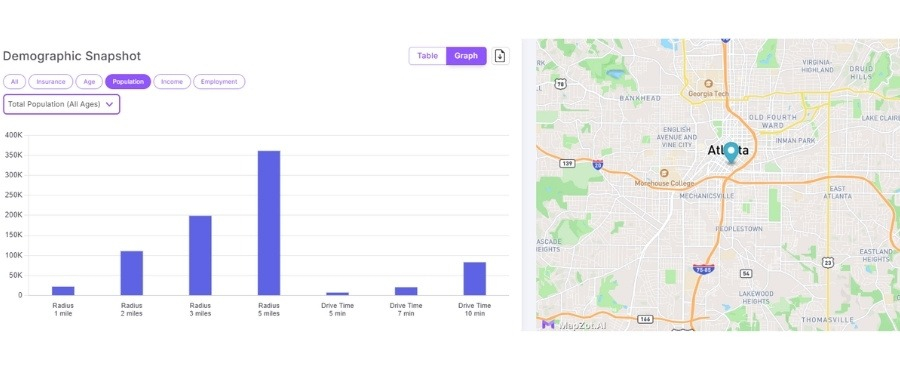
Location intelligence platforms can bring geographic, demographic, competitive, and mobility data together in one analysis.
For example, MapZot.AI can help pet retailers evaluate potential markets using factors such as pet-owner demographics, household income, competitor density, mobility patterns, trade areas, and customer behavior.
Instead of asking only:
"How many people live near this location?"
retailers can ask more useful questions:
Who lives near the location?
How many households are likely to own pets?
What is the local spending profile?
Where are competitors located?
Which competitors receive the most visits?
What complementary businesses are nearby?
How far are customers traveling?
Where is potential demand underserved?
Could a new location overlap with an existing store?
This broader perspective can make site evaluation more structured and data-driven.
Final Thoughts
For an organic pet store, choosing a location is about more than finding a busy shopping center.
The strongest opportunities can emerge where pet ownership, demographics, spending power, accessibility, consumer behavior, and retail supply intersect.
Geographic demographic factors provide the foundation, while mobility and competitive data add context about how customers actually behave.
By combining these signals through an organic pet store location analysis, retailers can identify promising markets, evaluate individual sites, understand competitive gaps, and build a more informed expansion strategy.
The right location is not necessarily where the most people are.
It is where the right customers are most accessible to the right store.