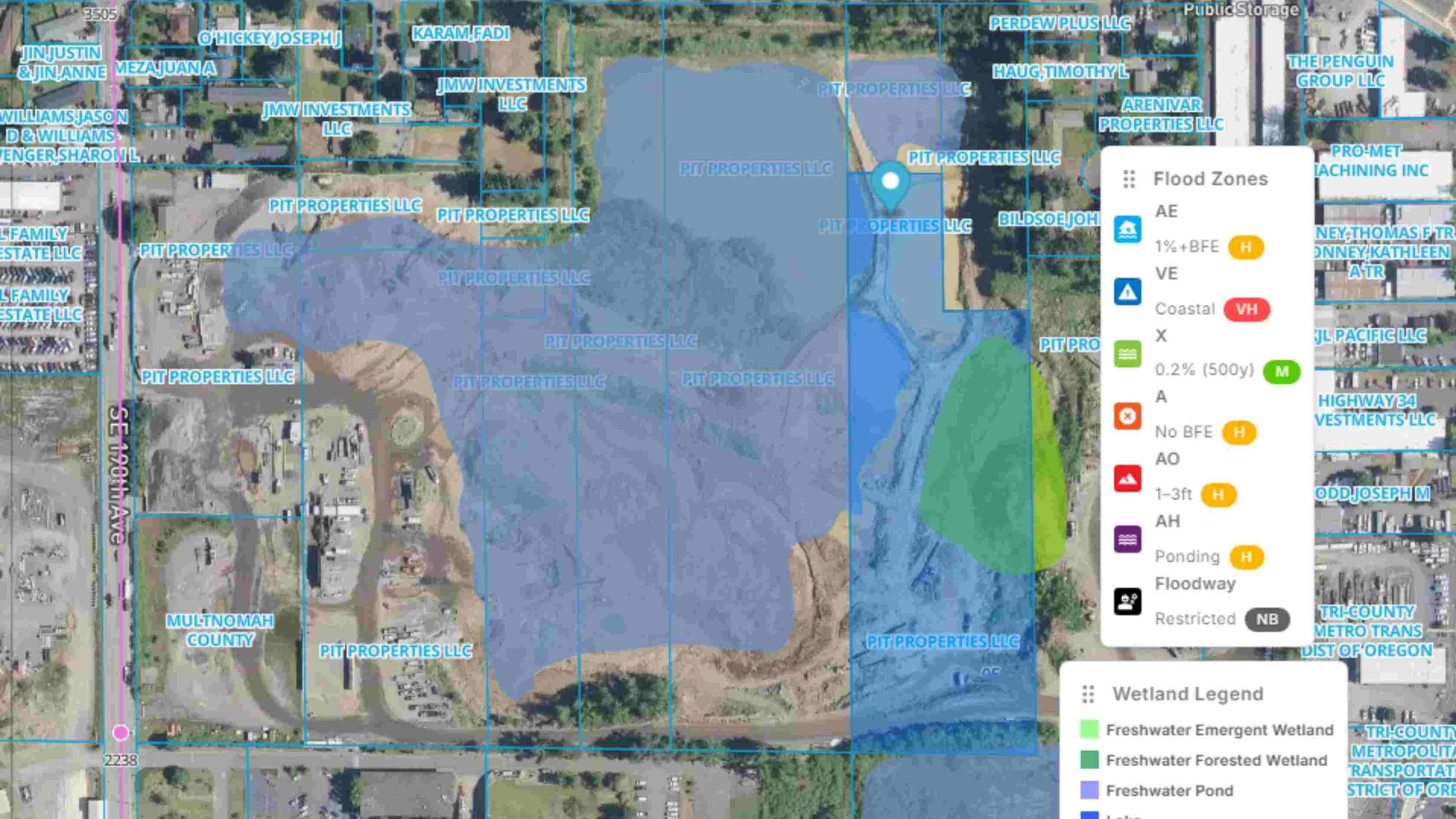
Climate risk is becoming a location decision not just an insurance or sustainability issue.
For years, commercial real estate site selection has focused on questions like:
- How much foot traffic does the area generate?
- Is the population growing?
- What does the competitive landscape look like?
- Can customers and employees easily access the site?
- What are rents, property values, and development costs?
Those factors still matter. But there is another question increasingly entering the site-selection conversation:
How resilient is this location to climate-related risk?
Flooding, wildfire, extreme heat, severe storms, drought, and other hazards can affect a property's operating costs, insurance, accessibility, asset value, and long-term viability. Recent CRE research shows that physical climate risks are increasingly influencing how developers, investors, lenders, owners, and tenants evaluate properties.
That means climate risk is moving closer to the beginning of the real estate decision-making process when companies are deciding where to build, acquire, lease, expand, or invest.
Key Takeaways
Climate risk is becoming an important factor in commercial real estate site selection.
Flooding, wildfire, extreme heat, storms, drought, and other hazards can create operational and financial risks for properties.
A strong site-selection strategy should evaluate climate exposure alongside market and location fundamentals.
Location intelligence can help CRE teams layer multiple datasets to compare potential sites.
Climate risk should not necessarily eliminate a location—it should help decision-makers understand the trade-offs and plan accordingly.
Why Climate Risk Matters in Commercial Real Estate
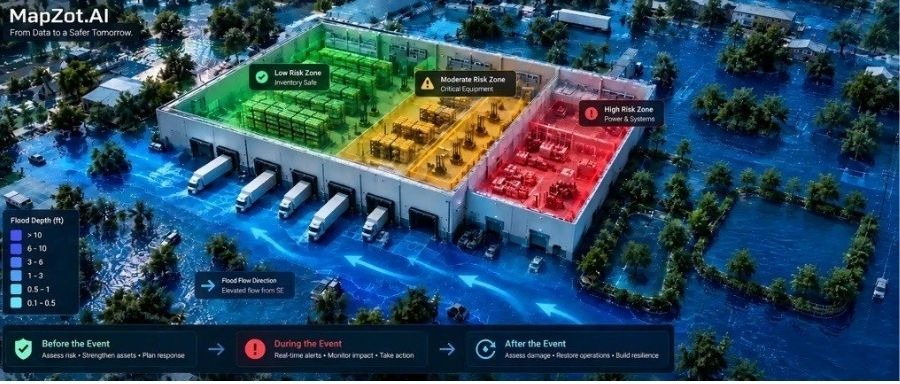
Climate-related hazards can affect real estate in several ways.
A flood can disrupt access to a property, damage infrastructure, or increase insurance and maintenance costs.
Wildfire risk can affect both the physical asset and the surrounding community.
Extreme heat can increase energy demand and operating costs, while severe storms can create disruptions for businesses, employees, customers, and supply chains.
These risks are not purely theoretical. Research from the CREDA Research Foundation notes that physical climate hazards have been reshaping how the commercial real estate industry evaluates risk, with rising insurance costs and greater scrutiny from investors, lenders, tenants, and property owners.
The Federal Housing Finance Agency's research also highlights the relationship between real estate and physical climate risks including flooding, wildfire, and sea-level rise, as well as transition risks associated with energy use and decarbonization.
For CRE teams, this creates a simple shift:
The question is no longer just "Is this a good location?"
It is increasingly:
"Is this a good location—and what risks could affect its performance over time?"
Climate Risk Is More Than Flood Risk
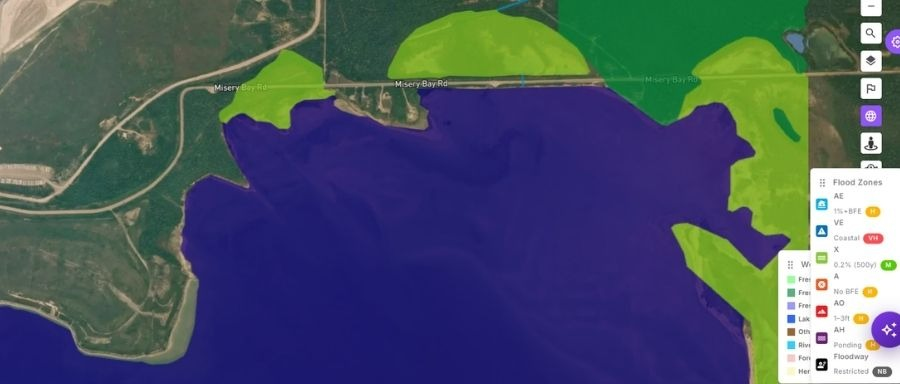
When people hear "climate risk," flooding is often the first thing that comes to mind. But commercial properties can be exposed to multiple hazards.
Depending on the location, a site-selection analysis may need to consider:
1. Flood Risk
Flooding can affect property, roads, parking areas, utilities, and surrounding infrastructure.
A property doesn't necessarily need to sit directly on a coastline to face flood exposure. Rainfall-driven flooding and drainage issues can also affect inland locations.
The U.S. Climate Resilience Toolkit's National Risk Index includes multiple flood categories, including coastal and rainfall-induced flooding.
2. Wildfire Risk
Wildfire exposure can influence development decisions, insurance considerations, property protection requirements, and business continuity.
For businesses evaluating multiple markets, understanding wildfire exposure can provide another layer of information when comparing otherwise similar sites.
3. Extreme Heat
Heat can affect both people and buildings.
For commercial properties, prolonged periods of extreme heat can influence energy consumption, HVAC requirements, employee comfort, customer experience, and operating costs.
4. Severe Storms and High Winds
Hurricanes, tornadoes, hail, and high winds can create physical damage and operational disruption.
For businesses that depend heavily on uninterrupted operations or customer access, these risks can become particularly important during site evaluation.
5. Drought and Water Risk
Water availability can matter significantly for certain industries, including manufacturing, agriculture-related businesses, hospitality, food production, and data centers.
A site's long-term water conditions may therefore become part of the location decision—not simply an environmental consideration.
The U.S. Climate Resilience Toolkit provides location-based information across hazards including drought, extreme heat, flooding, wildfire, and severe weather, illustrating the breadth of factors that can be incorporated into resilience planning.
The Shift From Site Selection to Risk-Aware Site Selection
Traditional site selection often follows a relatively straightforward process:
Market → Demographics → Competition → Accessibility → Property → Financials
Climate risk adds another layer:
Market → Demographics → Competition → Accessibility → Climate Risk → Property → Financials
But the goal isn't to treat climate risk as a standalone score.
The more useful approach is to combine it with the rest of the location picture.
For example, imagine two potential sites have similar population growth, traffic, income levels, and competitive conditions.
One location may have significantly greater exposure to flooding or wildfire.
That doesn't automatically mean Site A is better than Site B.
Instead, it gives the real estate team another variable to investigate:
What would mitigation cost?
How could insurance affect the economics?
Could access be disrupted?
How resilient is the surrounding infrastructure?
Could the risk affect future demand?
Does the opportunity justify the additional exposure?
This is where location intelligence becomes valuable.
Climate Risk Can Change How Markets Are Compared
Climate risk becomes especially useful when evaluating multiple markets.
Consider a retailer planning its next 20 locations.
Instead of asking only:
Which markets have the highest growth potential?
The company could also ask:
Which high-growth markets offer the right combination of demand, accessibility, competition, and climate resilience?
This creates a more balanced approach to market expansion.
The same principle applies to:
Retail
Restaurants and QSRs
Industrial
Logistics
Healthcare
Banking
Multifamily
Office
Hospitality
Data centers
Commercial developments
The importance of each climate factor will vary by industry. For example, flooding may be particularly important for a logistics operation where road accessibility is critical, while water availability may deserve greater attention for a water-intensive industrial operation.
Final Thoughts
Climate risk is no longer something commercial real estate teams can treat as an afterthought.
As physical hazards, insurance considerations, operating risks, and resilience increasingly influence property decisions, climate exposure is becoming another important variable in evaluating where businesses build and invest.
The most effective site-selection strategy won't be about avoiding every location with climate risk.
It will be about understanding the risk, comparing it against the opportunity, and making a more informed location decision.
Because in commercial real estate, the best location isn't simply the one that performs well today.
It's the one that continues to make sense as the market changes.