For five weeks this summer, Atlanta became one of the world's busiest soccer capitals. Mercedes-Benz Stadium hosted eight FIFA World Cup 2026 matches, including a semifinal, and the final numbers are now in. The story they tell for Georgia is more interesting than a single headline figure: real wins in visitor spending, transit and room rates, but also surprises in hotel occupancy and open questions about who benefits.
In this analysis, the MapZot.AI team looks at the tournament's impact on Georgia's economic development across five dimensions: cities and destinations, tourism and hotels, restaurants and bars, development and capital inflow, and jobs.
Key takeaways
Fan Fest drew 500,000+ people, nearly matching the 544,516 who attended matches in the stadium.
Hotels booked 442,000 room nights, but occupancy slipped about 4% while revenue per available room rose 11%. This was a pricing story, not a volume story.
Neighbouring cities such as Decatur built their own fan zones to capture overflow spending, with projections of $62.6M to $142.5M.
Federal and private capital arrived in the form of $73.4M in FEMA-backed allocations, small-business grants and short-term-rental spending.
Job figures are still mostly projections; the evidence of lasting employment gains is yet to come.
The big picture: forecasts vs. reality
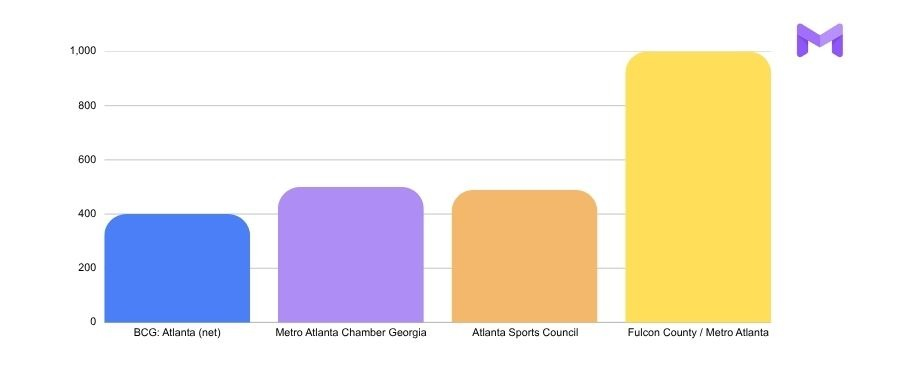
Before the tournament, estimates of its economic impact varied widely depending on who was counting and what they included. The Metro Atlanta Chamber's out-of-state-visitor model put the impact on Georgia at about $503 million. A Boston Consulting Group analysis estimated roughly $415 million in net benefit to Atlanta, while Fulton County leaders and other boosters talked about $1 billion for the metro area.
The spread matters. Sports economists such as Victor Matheson have long cautioned that mega-events rarely deliver the largest projections, because visitor spending often displaces other local spending. That caution is a useful lens as the post-event data arrives.
Cities and destinations
The stadium sits in downtown Atlanta, but the economic footprint was wider. Atlanta itself turned Centennial Olympic Park into its Fan Fest and Piedmont Park into a mass viewing area, while the city's South Downtown corridor and the Atlanta BeltLine were pitched as long-term redevelopment beneficiaries.
Decatur: the overflow play
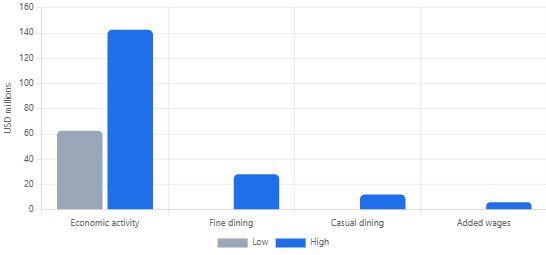
About six miles away, the City of Decatur, with a population of roughly 25,000, built a month-long WatchFest positioned as a more relaxed and affordable alternative to attending matches. An Emory University economist's report projected between $62.6 million and $142.5 million in economic activity, between 3,500 and 10,000 visitors per day, and up to $5.9 million in additional wages.
Statewide reach
Georgia's tourism base gave the tournament a platform to build on. In 2024 the state welcomed about 174 million visitors who spent $45 billion, producing an $82 billion overall impact and supporting more than 470,000 jobs. Destination marketers from Savannah to the north Georgia mountains used the tournament's global attention to pitch longer stays.
Tourism and hotels
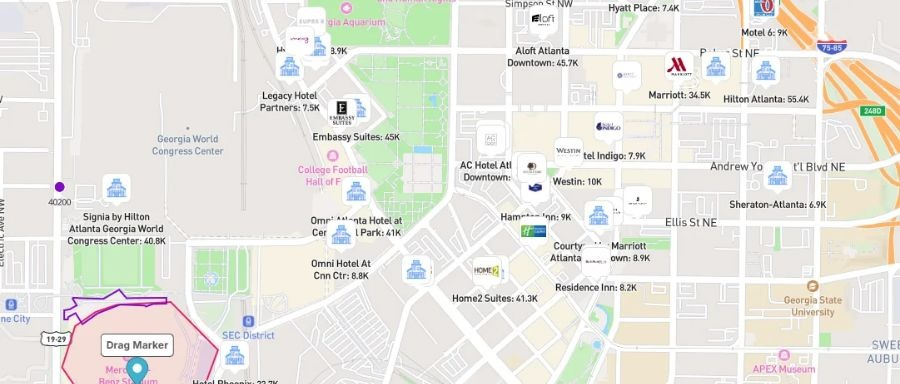
Citywide averages hide a lot. When we map hotel visit volumes around Mercedes-Benz Stadium, the downtown core splits into clear winners. The map below covers the walkable zone between the stadium, the Georgia World Congress Center, Centennial Olympic Park and the Peachtree Street corridor, with each pin labelled with its visit count.
Hilton Atlanta (55.4K), Embassy Suites (45K), the Omni at Centennial Park (41K) and the Signia by Hilton at the Georgia World Congress Center (40.8K) sit in the top tier. These properties are closest to the stadium, Fan Fest in Centennial Olympic Park and the convention complex, and they are built to absorb large groups. That matches the tournament's overall shape: a surge of event-driven demand concentrated in a small downtown footprint.
Aloft Atlanta Downtown (45.7K) and Home2 Suites (41.3K) rival the big full-service names. For fans staying several nights, rooms with kitchenettes or a lower nightly rate were clearly attractive, and these brands show that the middle of the market captured real traffic rather than just the luxury end.
Hotels such as the Westin (10K), Hampton Inn (9K), Motel 6 (9K), Courtyard Marriott (8.9K), Residence Inn (8.2K), Hotel Indigo (7.9K), Hyatt Place (7.4K) and the Sheraton (6.9K) show far lower volumes. Some of this is capacity, and some is location: several sit a few blocks east toward Peachtree Street and Georgia State University, away from the stadium and Fan Fest. Meanwhile, newcomer Hotel Phoenix, which opened only months before kickoff, shows roughly 22.7K visits, a solid figure for a property that was still introducing itself to travellers
Development and capital inflow
Capital came into Georgia through several channels:
Public safety and operations funding. FEMA's FIFA World Cup Grant Program awarded Atlanta more than $52 million for staffing, communications, emergency equipment and inspections, as part of a $73.4 million allocation to the Atlanta World Cup Host Committee.
Small-business support. Local grants such as Invest Atlanta's helped restaurants upgrade ahead of the matches.
New hospitality supply. Properties like Hotel Phoenix opened months before kickoff, betting on the tournament to introduce them to travellers.
Urban redevelopment. The South Downtown corridor and a continuous 70-mile BeltLine trail were positioned as tournament-timed milestones.
Visitor spending. Airbnb-related guest spending alone was projected at $70M of activity.
What comes next
Tourism leaders view the tournament as a success that strengthens Atlanta's case for future mega-events and conventions, and business owners are already looking ahead to the 2028 Super Bowl. The tournament's lasting legacy will depend on three things:
Repeat visitation. Do international fans return, as FIFA's 65% assumption suggests?
Local retention. Do vendor programmes and small-business grants keep dollars in Georgia?
Equitable benefit. Community coalitions such as Play Fair ATL pushed for protections against displacement; how that plays out will shape public support for the next event.