
Georgia's largest majority-Hispanic city is where retail, jobs and immigration policy collide. Twelve months after enforcement intensified, local leaders say the customers are coming less often. Here is what the data shows, and what it can't yet show.
Key Takeaways
Dalton is the most exposed city in Georgia. With more than half of residents Hispanic and 28.1% foreign-born, Hispanic-serving retail is a core part of the local economy.
Local signals point one way. A Dalton advocacy leader says Hispanic business owners report customers visiting less often, and a pastor says residents are limiting outings after the Dec. 30 arrests.
Measured benchmarks suggest the scale. Peer-reviewed and university analyses find average foot-traffic drops of about 1–3% near enforcement, with 8–11% at the hardest-hit sites.
Spending falls harder than visits. A national study found spending dropping 6.9% against a 2.9% visit decline.
Data gap: no public, address-level foot-traffic series for Dalton's Hispanic corridors exists yet. This report is explicit about what is measured and what is inferred.
A city built by immigrant labor, now holding its breath
Dalton calls itself the Carpet Capital of the World, and the label was earned by people who came to work. Beginning in the late 1980s and 1990s, the mills drew waves of workers from Mexico and Central America, and those workers stayed, raised families and opened businesses. Today the city's schools, churches and commercial strips carry their imprint.
That history is also why the city is nervous. Dalton lived through immigration raids on its biggest carpet mills in the 1990s, and the memory has resurfaced with each new round of enforcement. Many of the people now wondering whether it is safe to go out for groceries are long-time residents, and a large share of them are legal residents or U.S. citizens.
Start with who lives here. The Census Bureau counted 34,417 residents in Dalton in 2020, and ACS 2020–2024 estimates put the Hispanic or Latino share of the city at 54.7%, compared with 37.2% across Whitfield County and 11% statewide. Foreign-born residents make up 28.1% of the city population.
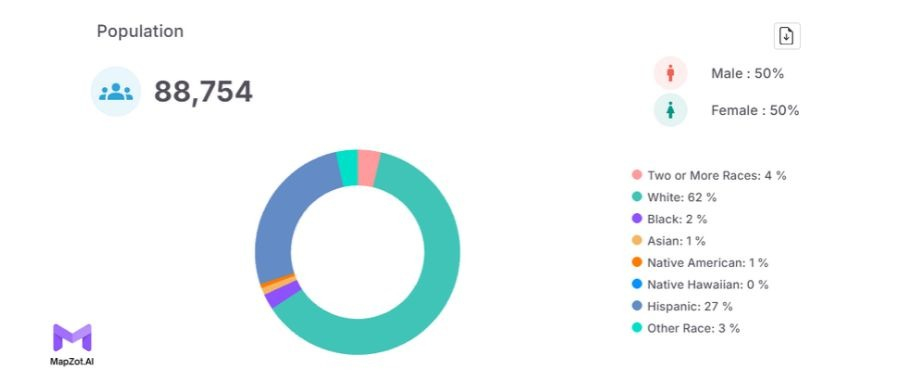
Across this wider 88,754-person market area, Hispanic residents are 27% of the population, roughly half the share found inside the city limits. That gap matters for retail. It means Hispanic-serving demand is concentrated in a handful of neighborhoods and corridors rather than spread evenly, so a drop in visits there shows up sharply on the businesses that depend on it, even when the area-wide numbers look steady.
The wider Dalton metro area, with about 146,400 people, is 32.5% Hispanic, still well above the 20% national share.
The last 12 months: a timeline of fear
Spring 2025
A 19-year-old Dalton State student is detained by ICE after a mistaken local stop, becoming one of the highest-profile cases in the community, according to reporting by the Atlanta Journal-Constitution.
June 2025
Enforcement surges in Los Angeles, creating the first large dataset on how raids change retail visits. Dalton leaders tell reporters that everyday life in town changed once Trump's second term began.
Dec. 30, 2025
Roughly 40 arrests in and around Dalton, many during the morning commute, per immigrant-serving group CLILA. The Dalton Police chief says his agency was not involved. A pastor says residents began limiting their outings.
Jan. 2026
AJC reports the city "reeling" after the Dec. 30 operation. Advocates say arrests tied to the Whitfield County 287(g) program add to the pressure.
July 2026
Latino Community Fund Georgia releases the state's first immigrant business study: more than 124,000 immigrant-owned businesses, roughly one in five Georgia entrepreneurs.
Oct. 2026
A University of Pennsylvania (Wharton) analysis of 5,388 geocoded ICE activity sites quantifies the "ICE tax" on local commerce. Georgia candidates campaign in Dalton on immigration and affordability.
Hispanic shoppers are pulling back, and brands are saying so
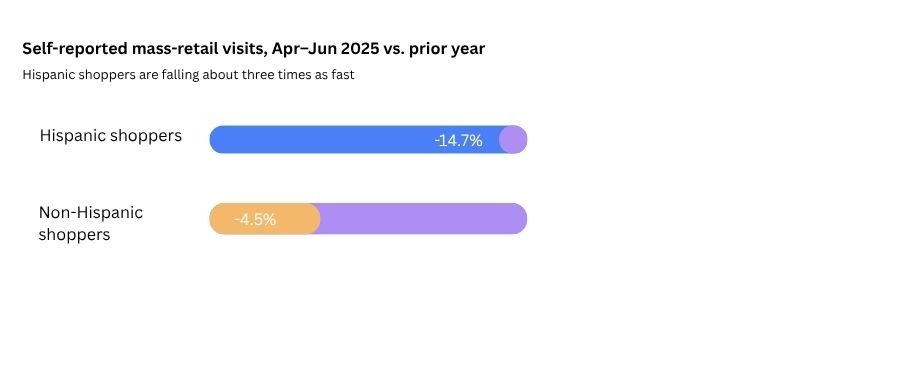
MapZot.AI surveys about 36,000 shoppers a year, roughly 7,000 of them Hispanic. Between April and June 2025, self-reported visits by Hispanic shoppers to mass retailers fell 14.7% year over year, against 4.5% for non-Hispanic groups.
Corporate commentary echoes it. Heineken's CEO said Hispanic customers have been "highly disrupted" by the raids. Constellation Brands, Colgate-Palmolive and Coca-Cola have flagged softer Hispanic spending, and Jack in the Box and Wingstop have cited reduced traffic in heavily Hispanic regions, according to eMarketer. Shoe Palace, which caters to Hispanic shoppers, said it saw a "huge decline in traffic" while its online sales held up better, a pattern that suggests the demand hasn't vanished, it has moved indoors and online.
What a slowdown could look like on a Dalton strip
To translate the benchmarks, imagine a Hispanic-serving storefront in Dalton that did 100 visits in a baseline week. For Hispanic-owned businesses the picture can be starker than the averages. UCLA's own researchers note that the 1–3% average, and 11% at the worst site, understate the hit to Latino-owned stores because their customers are concentrated in the affected communities.
What retailers, landlords and lenders should do now
Retailers and franchisees: Track weekly visits by daypart. Shift promotions to delivery, pickup and online ordering, which shoppers appear to be favoring, and use daytime hours when fear is lower.
Landlords and brokers: Stress-test rent rolls for Hispanic-anchored centers with a 3–11% visit decline. Watch co-tenancy clauses and renewal timing.
Lenders and economic developers: Compare visit trends against pre-2025 baselines at the corridor level, not just city totals, to spot distress early.
CPG and grocery brands: Expect softer in-store velocity in Hispanic-heavy trade areas and test multicultural e-commerce.